When a player loses their valuable CS2 inventory to a scammer, their first instinct is to contact Steam Support. They submit a ticket, explain the situation, provide screenshots of the phishing link or the fake trade window, and wait for a support agent to reverse the trade and return their items.
Inevitably, they receive an automated response stating that Steam Support does not restore items that have left an account.
For a victim who has just lost hundreds or thousands of dollars, this policy feels incredibly unfair and frustrating. However, to understand why Valve strictly enforces this rule, we have to look at the history of the Steam economy and how the policy evolved.
The Era of Item Duplication
Before 2016, Steam Support did occasionally restore scammed or hijacked items. If you could prove your account was hacked and your items were stolen without your consent, Valve would use their backend tools to generate new copies of those items and place them in your account.
This seemingly generous policy created a massive, economy-breaking problem: Item Duplication.
Here is what happened:
- A hacker steals a $1,000 Karambit | Fade.
- The hacker immediately sells the Karambit to an innocent third-party trader for cash, or trades it through a network of bots.
- The original owner contacts Steam Support.
- Steam Support cannot simply take the knife away from the innocent third-party trader who paid for it in good faith.
- Therefore, Steam Support would create a duplicate of the Karambit Fade and give it to the victim.
Now, there are two identical Karambit Fades in the economy.
The Duplication Exploit
It didn't take long for malicious actors to realize they could weaponize this policy to print money.
Two friends would collude. Player A would "hack" Player B (they just shared the password). Player A would take Player B's ultra-rare knife and sell it on the market. Player B would then cry to Steam Support that they were hacked. Steam Support would restore the knife to Player B.
The two friends now successfully multiplied their wealth, injecting a duplicate high-tier item into the market. This rampant duplication was destroying the rarity and value of CS:GO skins.
The Introduction of Steam Guard and the Policy Shift
To stop the duplication crisis, Valve fundamentally changed how Steam security worked.
In late 2015, they introduced the Steam Guard Mobile Authenticator. This shifted the responsibility of security entirely onto the user. By requiring a physical smartphone to approve trades and market listings, Valve established a new baseline: A trade cannot occur without the user's explicit, physical confirmation.
Along with the Authenticator, Valve updated their Item Restoration Policy to its current, strict form:
"Steam Support does not restore items that have left accounts for any reason, including in cases of account hijacking or fraud... Providing a duplicate item would decrease the value of all other items in existence."
The Brutal Reality of the Current System
Valve's stance is that by providing the Mobile Authenticator, they have given users the ultimate tool to protect themselves. If an item leaves your account, it means one of two things occurred:
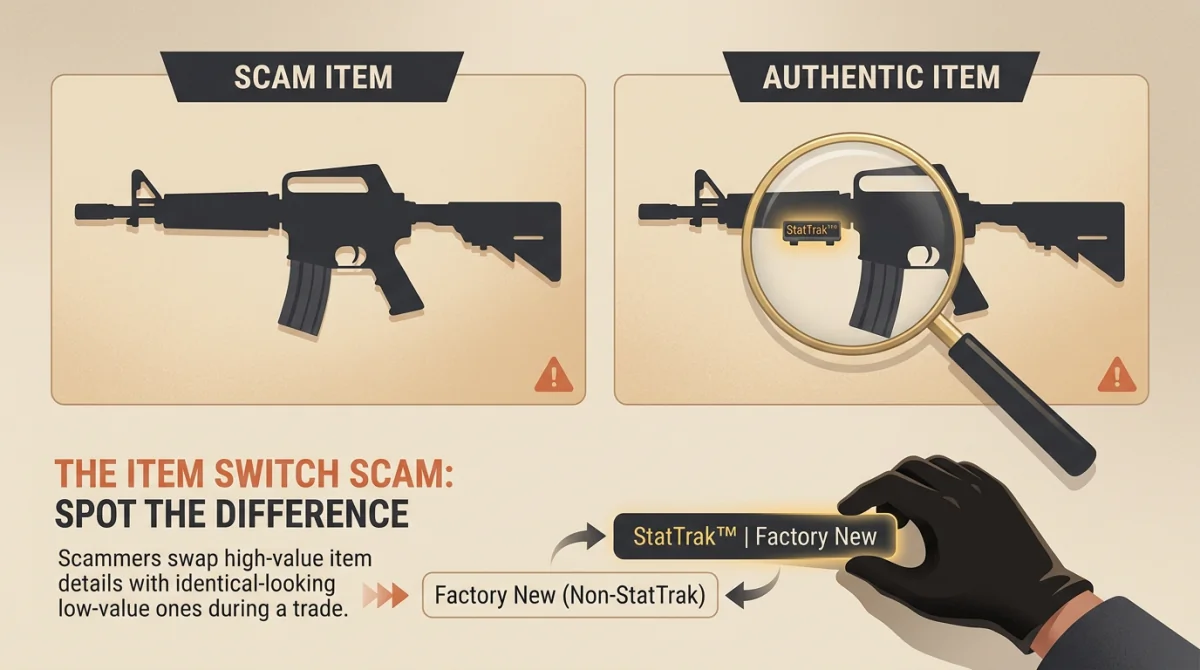
- You approved the trade on your phone. (Even if you were tricked by an API scam or an item switch, you still clicked 'Accept' on the final confirmation screen).
- You allowed your phone to be compromised. (e.g., you scanned a malicious QR code, granting a hacker total access).
In Valve's eyes, both scenarios are user errors, not system failures.
Reversing trades (taking the item back from the scammer) is often technically impossible because scammers move items rapidly through complex networks of mule accounts, often ending up in the hands of innocent buyers on third-party sites within hours.
The Takeaway
Understanding this policy is the most important lesson in CS2 trading.
There is no safety net.
If you make a mistake, if you click the wrong link, or if you don't double-check the Mobile Authenticator, your items are gone forever. Steam Support will ban the scammer if you provide evidence, but they will never return your pixels.
This lack of a safety net is exactly why educating yourself on the latest scam methods, utilizing proper security hygiene, and maintaining a healthy sense of paranoia is absolutely critical for anyone participating in the CS2 economy.