So, What Actually Is Fade Percentage?
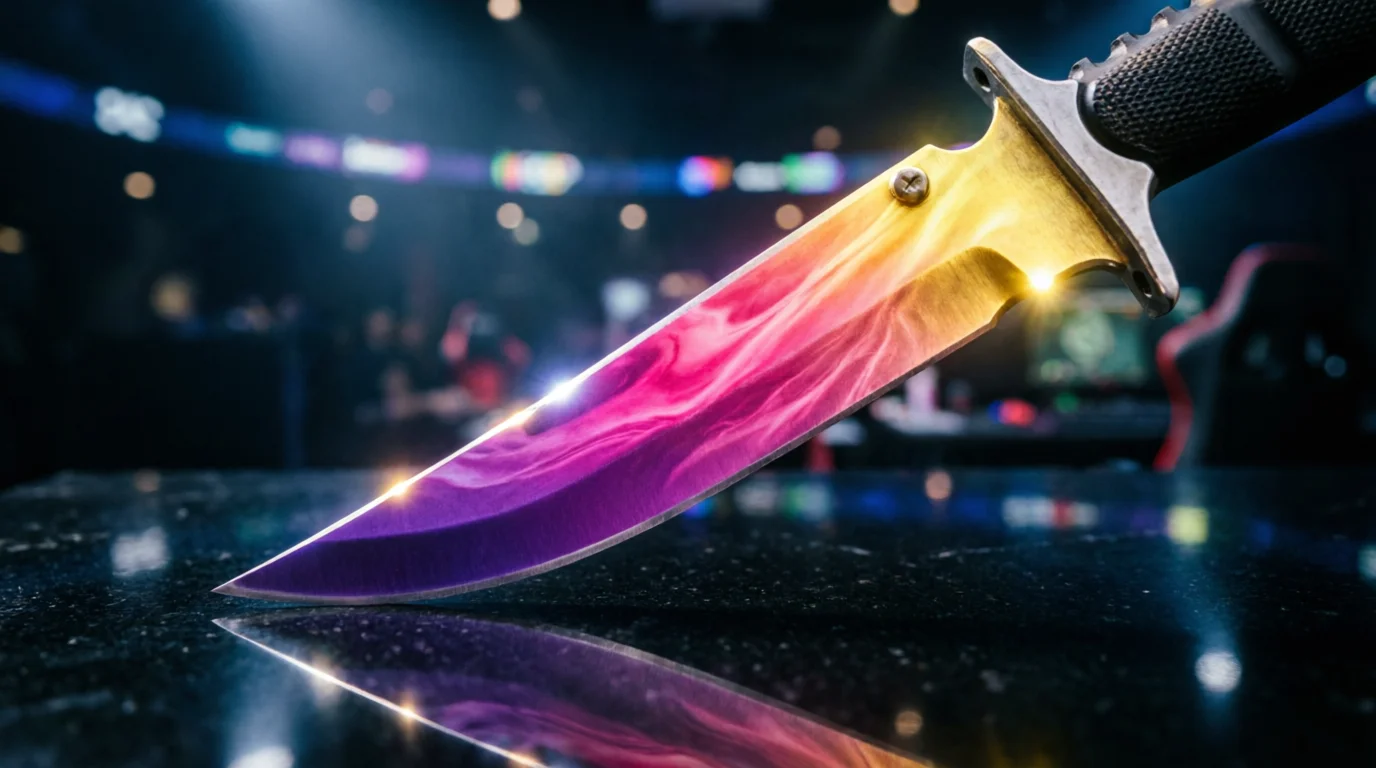
At its core, Fade percentage is a measure of how much of the full color gradient is present on the skin. Think of it as a spectrum slider. On one end, you have a "low fade" where the purple/pink colors dominate, and the vibrant yellow or gold is barely visible or completely absent. On the other end, the mythical "100% Fade" or "Full Fade," where the gradient runs its complete course: deep purple at the base, through rich pink/red, all the way to a bright, clean yellow at the tip.
The percentage isn't an official Valve stat. It's a community-created metric to quantify desirability and rarity. It typically ranges from about 80% to 100%. A 90% Fade will have some yellow, but it might be muted or only on the very edge. A 100% Fade has the maximum possible amount of yellow, making the colors "pop" more dramatically. This isn't just about yellow for yellow's sake; it's about the full, intended visual spectacle of the finish being completely realized.
The Engine Behind the Paint: Pattern Seeds
Here's where the magic—and the math—happens. Every skin in CS2 with a pattern-based finish (like Fade, Case Hardened, Crimson Web) has a Pattern Index or seed, a number between 0 and 999. This seed is the DNA of the skin; it tells the game's engine exactly how to map the texture onto the 3D model of the weapon or knife.
For Fade finishes, this seed directly controls the offset of the gradient. Imagine the Fade gradient is a long, colorful banner. The pattern seed determines where on that banner your specific weapon is "cut from." A low seed number might cut a piece that's mostly purple. A high seed number might cut a piece that includes the very end of the banner, where all the yellow lives.
Why 100% Fade Commands a King's Ransom
It boils down to three things: visual appeal, objective rarity, and market psychology.
Visually, a 100% Fade is simply the best version of the skin. It's the most vibrant, the most complete, and the most "Fade-y" a Fade can be. It has the highest contrast. On a play skin you stare at for hundreds of hours, that difference matters. It's the difference between a nice skin and a centerpiece skin.
Market psychology then takes over. In a community that venerates "max" versions of anything—max blue Case Hardeneds, "scar" patterns, low-float gems—the 100% Fade becomes the undisputed trophy. It's the definitive, no-argument-possible "best in slot." This creates a massive demand funnel targeting an extremely limited supply. The price isn't just for the skin; it's for the status, the completionism, and the bragging rights of owning the pinnacle variant.
From what I've seen, the price jump isn't linear. It's exponential. A 95% Fade might be 20% more expensive than a 90%. A 98% might be double the price of the 95%. And a true, verified 100% can be 5x, 10x, or even more compared to a 90% on the same knife. It's a market driven by collectors, not players looking for a simple play skin.
How to Check Your Fade Percentage: Don't Guess, Use Tools
Never, ever trust a seller's word on fade percentage alone. "Trust me bro" has cost traders thousands. The process is straightforward and relies on community-built infrastructure.
- Get Your Inspect Link: In your Steam inventory, right-click the Fade skin and select "Copy Inspect Link."
- Use a Dedicated Site: The go-to resource for years has been CSGOFloat's Fade Calculator (or similar, reliable market inspection sites). These sites have databases that map every single pattern seed for Fade skins to its calculated percentage.
- Paste and Analyze: Paste your inspect link. The tool will read the pattern index from the game's API, reference its database, and spit out a percentage. For knives, it will often show a visual reference and rank it (e.g., "98% Fade, Rank #45 out of 1000").
The Fade Family: Which Weapons Have This Finish?
Fade isn't as common as Doppler or Slaughter. It's a specific, coveted finish found on a select group of items, primarily from the early case eras.
The Knives (The Big-Ticket Items): This is where the most drama and money resides. Fade finishes are available on many classic knife models from the original Chroma, Chroma 2, and Gamma cases (and their subsequent inclusions in other collections). Key players include:
- Karambit Fade: The poster child. The "Fake 90/10," "90/10," "90/5/5," and "90/3/7" debates here are legendary and predate simple percentage tools. A true 100% Karambit Fade (a "90/10") is one of the most iconic and expensive trade-up items in the game.
- M9 Bayonet Fade: Known for its more subtle fade band on the blade. A true 100% M9 Fade is arguably rarer than the Karambit.
- Butterfly Knife Fade: The playability king. A max fade Butterfly is a shimmering, golden spectacle in motion. The demand is insane.
- Bayonet Fade, Huntsman Fade, Falchion Fade, Shadow Daggers Fade, etc.: All follow the same rules, with their own unique desirability curves.
The Guns (The Attainable Classics):
- Glock-18 | Fade: The most famous gun Fade. It's a community treasure. A 100% Fade Glock with a clean float is a permanent fixture in high-tier loadouts. The price difference here is stark—a 95% might be a $700 skin, while a 100% can easily breach $2000.
- MAC-10 | Fade: A more recent, but incredibly popular addition. It's a loud, proud, and relatively affordable way to rock a Fade finish. Fade percentage matters here too, affecting the amount of yellow on the muzzle.
- AWP | Fade: This is a rare bird. It's not from a regular case; it was a promotional item for the "Welcome to the Clutch" music kit. Its fade pattern works differently, covering the whole body, and its rarity makes it a collector's piece where "max fade" is also a sought-after trait.
I personally think the gun Fades are where newer collectors can really feel the impact of percentage. On a knife, you might be dealing with tens of thousands of dollars. On a Glock, you can directly compare a "pretty good" fade to a "perfect" one and see the $1000+ price gap in real time. It's a perfect microcosm of the entire market.
90% vs. 100%: A Price Chasm, Not a Gap
Let's talk numbers, because that's what it's all about. The price difference isn't a slight markup; it's a valuation of rarity and prestige.
For Knives: Using a Butterfly Knife Fade as an example (prices are approximate and fluid):
- A 90-95% Fade (Field-Tested to Factory New): Might trade in the range of $2,000 - $3,000. It's a beautiful, high-tier play skin.
- A 100% Max Fade (Factory New): Can command $5,000 to $8,000 or more. The right buyer, at the right time, will pay a massive premium. This multiplier effect is even more extreme on rarer base knives like the M9.
For the Glock-18 | Fade:
- A 95% Fade (Factory New): You're looking at roughly $700 - $900.
- A 100% Fade (Factory New): The price quickly jumps to $1,800 - $2,500+. It's not just a better Glock; it's a status symbol, often paired with expensive stickers that rival the cost of the gun itself—think tier-2 Katowice 2014 holos like a Sticker | Team LDLC.com (Holo) | Katowice 2014 or a Sticker | Vox Eminor (Holo) | Katowice 2014.
Final Thoughts: Is Chasing Max Fade Worth It?
Honestly, that depends entirely on your goals and budget.
- For the average player who just wants a cool, shiny Fade skin: A 90-95% Fade is absolutely the way to go. You get 95% of the visual effect for 30-50% of the price. It's still an incredible, eye-catching skin that will turn heads.
- For the collector, the investor, or the player for whom "best possible" is the only option: The hunt for a 100% Fade is the entire point. It's an endgame item. The premium you pay is for the satisfaction of knowing you have the pinnacle, and for the item's potential to hold or increase its value due to its objective rarity.
The real kicker is that unlike float, which can be a game of hundred-thousandths, a Fade percentage is a stark, visual cliff. You can see the missing yellow. That tangible, visible gap between "almost" and "there" is what the market monetizes so ruthlessly. Always use the tools, know exactly what you're buying, and understand that in the world of Fades, that last 5% isn't just a bit more paint—it's the difference between a great skin and a legendary one.