The Counter-Strike 2 skin market is complex. With thousands of skins, intricate float values, rare pattern templates, and fluctuating market trends, it can be overwhelming for a beginner to navigate safely. However, despite the technical sophistication of API hijacks and fake websites, the vast majority of scams still rely on a very basic human vulnerability: Greed.
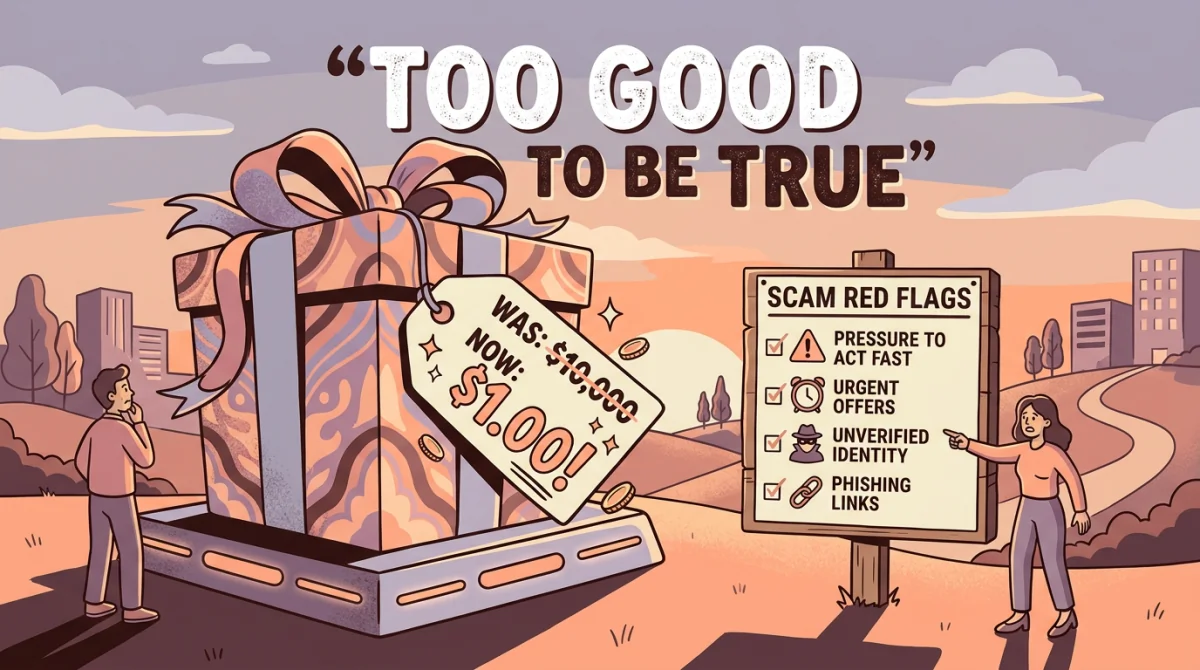
If you only learn one lesson about CS2 trading, let it be this: If an offer looks too good to be true, it is a scam.
This single heuristic, if strictly applied, will protect you from almost every trick in the book. Let's break down why this rule exists and how to spot the "Too Good to Be True" red flags.
The Reality of the CS2 Market
The CS2 economy is highly liquid and incredibly efficient. There are tens of thousands of active traders, sophisticated pricing algorithms, and massive third-party marketplaces.
In an efficient market, nobody gives away money for free.
If a skin is worth $500 on Buff163 or Skinport, anyone can sell it there for roughly that amount within a few hours. Therefore, if a random person in a Discord DM offers you $700 in cash for that same $500 skin, you must ask yourself: Why?
Why would they offer you $200 more than they could buy it for on a safe, instant marketplace? The answer is always: Because they have no intention of actually paying you.
Identifying the Red Flags
Here are the most common "too good to be true" scenarios that should immediately trigger your scam alarms.
1. The Massive Overpay
- The Scenario: Someone offers to trade their $300 knife for your $150 gloves, claiming they "just really like the gloves" or "need them to complete a loadout." Or, a cash buyer offers 120% of the market value for your inventory.
- The Reality: Legitimate traders look for profit or fair 1:1 trades. Massive overpay is the bait used to blind you to the hook (which will be a fake payment screenshot, an API hijack link, or an item switch at the last second).
2. The Unsolicited Giveaway
- The Scenario: You get a DM on Discord or a comment on your Steam profile saying you've been randomly selected to win an AWP Dragon Lore or a Karambit Gamma Doppler.
- The Reality: High-tier skins cost thousands of dollars. Strangers do not randomly select people to give thousands of dollars to. The link provided to "claim" your prize will be a phishing site designed to steal your Steam login.
3. The "Free Profit" Partnership
- The Scenario: Someone messages you claiming they have discovered a glitch on a gambling site, a rigged roulette wheel, or a secret trade-up formula. They want to "partner" with you: you provide the skins as capital, they use the glitch, and you split the massive profits.
- The Reality: If someone had a foolproof way to print money, they would use it themselves. They wouldn't share it with a stranger on the internet. They just want you to trade your skins to their "glitched" site (which they own) or to their account.
4. The "I Go First" Cash Buyer (With a Catch)
- The Scenario: A cash buyer agrees to buy your expensive knife and offers to send the PayPal money first. This lowers your guard. However, they insist on using a very specific "Middleman" from a Discord server you've never heard of, or they send an email/screenshot that says the money is "pending until item delivery."
- The Reality: They are setting up a fake payment scam or a fake middleman scam.
The "Move Off-Platform" Red Flag
Another massive red flag that often accompanies "too good to be true" offers is the insistence on moving off Steam.
If a trade requires you to:
- Log into a website you have never heard of to "verify your item's pattern."
- Download an obscure voice comms program to "discuss the trade." (This is usually malware).
- Trade your item to a third account as a "trust test" or "collateral."
- Join a specific Faceit hub via a provided link before they trade.
...then it is a scam. Legitimate Steam trades happen in the Steam trade window.
Cultivating a Healthy Paranoia
To survive in the CS2 trading scene, you must cultivate a healthy level of paranoia.
- Assume every random friend request is a scammer.
- Assume every unsolicited DM offering a trade is a scam.
- Treat your high-tier skins like physical cash. Would you hand a stranger $500 on the street because they promised to PayPal you $700 later?
When you encounter an amazing offer, take a deep breath, step away from the keyboard for five minutes, and ask yourself: Does this make logical economic sense?
If the answer is no, block the user, cancel the trade, and keep your skins safe.